Seymour’s Home Furniture
Casual Sofa Comfort: How to Assess Seat Depth, Cushions, and Fit
A sofa can look inviting from across the room and still feel wrong after ten minutes. The difference often comes down to a few practical details: how far the seat extends beneath you, where the cushions support your body, and whether the sofa’s dimensions suit both the room and the people using it. Here’s how to assess those details before you commit.
Published October 21, 2026
Comfort is not a single number. It is the result of a conversation between a person and a piece of furniture: posture meets cushion, legs meet floor, elbows meet arms. A casual sofa should accommodate ordinary life—reading, talking, taking a break, stretching out—without asking everyone to sit in exactly the same way.
Measurements help make that conversation less mysterious. Seat depth influences whether you can sit upright with your feet grounded or settle back into a lounge. Seat height affects how easily you rise. Arm height and width shape the way your shoulders and elbows rest, while cushion construction influences how the sofa feels after the first impression fades.
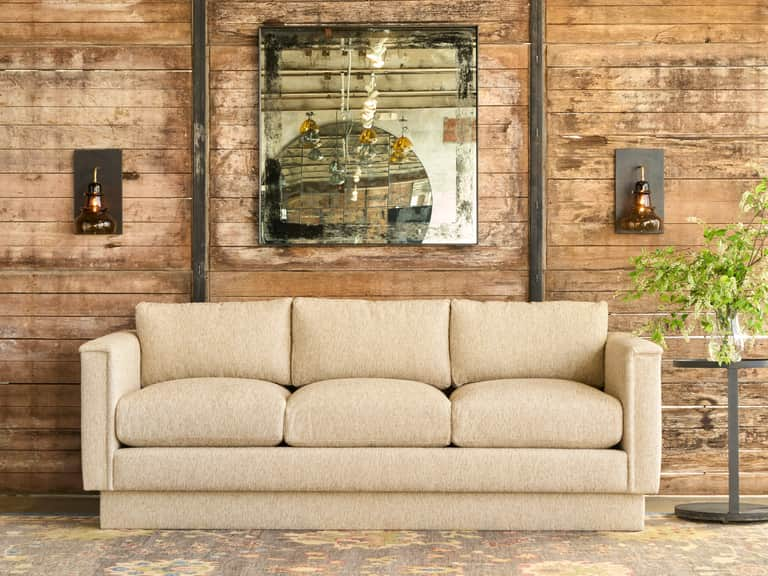
The Cisco Home Asher Sofa offers a useful case study. It has a reported sitting depth of 24 inches, a 19-inch seat height, a bench-style seat cushion, and five loose back cushions. At 96 inches wide and 41 inches deep overall, it is a substantial piece, but its measurements tell only part of the story. The best way to understand fit is to look at each dimension in relation to the way you sit and the room you have.
Start with the way you actually sit
Furniture shopping can make everyone look like a poised visitor in a showroom. Everyday life is less composed. You may sit forward while talking, lean into a corner to read, or put your feet up during a film. Before comparing sofas, think about the postures that fill most of your week—not just the one you assume you ought to prefer.
If you often sit upright, perhaps to have a conversation or read at a table, you may appreciate a seat that lets your back meet the back cushions while your feet rest comfortably on the floor. If you tend to curl up or recline, a deeper seat may feel more natural. A household with several people may need a sofa that supports more than one posture at once: upright at one end, relaxed at the other.
That distinction matters because “casual” does not mean “universally comfortable.” A relaxed silhouette may have deep seating, soft cushions, or a generous width, but those features do not guarantee that the seat will suit every body. The aim is not to find the sofa with the largest dimensions. It is to find one whose proportions make your usual posture feel easy.
Seat depth: upright perch or relaxed sprawl?
Seat depth is the distance from the front edge of the seat to the point where the seat meets the back. It is one of the clearest clues to how a sofa will encourage you to sit. A shorter effective seat depth can make an upright position easier to maintain. A deeper one gives more room to lean back, tuck up your legs, or shift into a lounging posture.
The word effective is important. A published sitting-depth measurement describes the seat, but loose back cushions can change how deep it feels in practice. Push those cushions forward and the usable seat becomes shorter; settle them farther back and the space available to sit may feel greater. The measurements are a starting point, not a substitute for trying the sofa in a position that resembles your real life.
The Asher’s listed sitting depth is 24 inches. That is a useful reference for shoppers who want room to relax, especially if they enjoy leaning back or occasionally sitting with their legs folded. Someone who prefers a more upright posture may find that depth generous. They might need to sit closer to the front edge or use a cushion behind the back to bring the support nearer.
There is no universal cutoff between “upright” and “deep.” Body proportions, preferred posture, and cushion compression all affect the experience. A person with longer legs may welcome room that feels excessive to someone with shorter legs. When you test a sofa, sit all the way back and check whether you can maintain contact with the back cushions while keeping your feet comfortably supported. If you cannot, try a different posture, adjust the cushions, or compare a shallower seat.
Seat height: the small measurement with daily consequences
Seat height is measured from the floor to the top of the seat cushion. It affects how your knees bend, how firmly your feet meet the floor, and how much effort it takes to stand. The Asher’s listed seat height is 19 inches. That number can help narrow a search, but it does not tell you how the sofa will feel once the cushions compress under your weight.
When testing a seat, notice whether your feet rest comfortably and whether your knees feel strained or overly raised. If your feet dangle, the sofa may feel too high for you; if your knees rise well above your hips, it may feel too low. These are not strict rules, but they are useful signals. People with mobility concerns or particular comfort needs should give this check extra attention and, where appropriate, seek advice tailored to their situation.
Seat height also changes how a sofa relates to the rest of a room. A lower-looking sofa can create a more relaxed visual profile, while a higher seat may feel easier to enter and leave. Think beyond the first sit: getting up repeatedly, sitting down with a cup or book in hand, and sharing the seat with another person are all part of the furniture’s daily job.
Cushion layout: one long seat, several separate places
A bench cushion is a single seat cushion that runs across much or all of a sofa’s width. It creates a continuous surface rather than a row of separate seat pads. On the Asher, the bench cushion gives the seat a clean, uninterrupted appearance and allows a sitter to shift position without encountering a gap between individual seat cushions.
That uninterrupted surface has practical trade-offs. It can be convenient for stretching out, and its visual simplicity may suit a streamlined room. But a single cushion may show creasing or compression in ways that differ from a multi-cushion seat. Depending on the upholstery and use, it may also need occasional straightening. Ask how the cushion is intended to be maintained and whether it can be turned or rotated; do not assume that every bench cushion is reversible.
Separate seat cushions divide the sitting area into visible sections. Some people like the sense of individual places they create. Others prefer a continuous bench because it feels less formal or makes it easier to lie down. Neither arrangement is inherently more comfortable. The deciding factors are the cushion’s support, the way it responds to weight, and the activities the sofa needs to accommodate.
The Asher pairs its bench seat with five loose back cushions. Loose cushions can be shifted to suit different postures, and they make it possible to rearrange the back support rather than rely on a single fixed shape. They also move with use and may need regular plumping or repositioning. When evaluating a sofa, try leaning against the back cushions in more than one spot. Notice whether they stay supportive or slide away, and whether the arrangement leaves enough room for your shoulders.
Support and softness are not opposites
Words such as “plush,” “firm,” and “supportive” are useful only up to a point. A soft first impression may feel pleasant, but comfort over time depends on how the cushion supports you as you settle. A firm seat may feel stable but not inviting if it does not suit your preferred posture. The goal is a balance: enough give to feel welcoming, enough support to avoid feeling as though you have sunk into a hollow.
Whenever possible, sit on a sofa for several minutes. Change positions. Lean back, sit near the front, and use the arm as you might at home. If the showroom visit is brief, pay attention to pressure points and how quickly the cushions recover after you stand. Ask the seller for details about the cushion construction, care instructions, and any available options. Product descriptions often tell you the cushion layout but may not provide every technical specification.
Construction matters as well. The Asher product information lists an FSC-certified wood frame and a no-sag support system. Those details describe elements of the sofa’s frame and support; they do not, on their own, determine whether its seat will feel right to you. A well-made sofa still needs to match your body, room, and routine. Treat construction information as one part of the decision rather than a substitute for assessing comfort.
Arms, back cushions, and the sense of fit
Dimensions can influence comfort in ways that are easy to overlook. The Asher’s listed arm height is 25 inches, measured from the floor. Arms may provide a place to rest your elbows, support a pillow, or lean against while sitting sideways. Whether they feel well placed depends on the height of the seat, your own proportions, and the posture you prefer.
Check whether the arms feel comfortable without forcing your shoulders upward. Try resting an elbow on them and sitting beside them rather than only in the middle of the sofa. A broad arm can be useful as a surface, but it also reduces the width available for seating. A narrow arm may preserve more sitting space while offering less room to lean or rest an object.
Back cushions deserve the same scrutiny. Loose cushions allow adjustment, but their arrangement can change the effective seat depth and the amount of back support available. If you like to sit upright, test whether the cushions support your lower and upper back in a natural position. If you lounge, check whether you can move them without the sofa becoming uncomfortable for the next person.
Measure the room—not just the sofa
A comfortable sofa must fit its room as well as its occupants. The Asher is listed at 96 inches wide, 41 inches deep, and 28 inches high overall. Its sitting space is listed as 79 inches wide by 24 inches deep. The difference between overall depth and sitting depth reflects the space taken up by the back and other parts of the sofa. It is the overall measurement that matters when planning placement.
Measure the intended area, then mark out the sofa’s footprint with painter’s tape or a comparable temporary outline. Include the full depth, not only the seat, and consider how close the sofa will sit to walls, tables, doors, and circulation routes. A sofa that technically fits may still make a room feel cramped if there is too little space to walk around it or pull out a chair.
Also measure access to the room. Doorways, hallways, stair turns, and elevators can complicate delivery, even when the sofa fits comfortably once inside. Confirm the product’s delivery requirements and the dimensions that need to pass through the tightest point. The Asher’s listed 96-inch width and 41-inch depth make that check especially worthwhile.
Finally, consider the visual balance of the room. A large sofa can anchor an open plan, but may overwhelm a small living area. A lower overall height can preserve sightlines, though it does not make a wide or deep piece take up less floor space. Use the sofa’s actual dimensions alongside the scale of surrounding furniture, rather than relying on a photograph or a room’s general impression.
A practical showroom test
Testing a sofa is more useful when you give yourself a short routine rather than a single ceremonial sit. Use the following checks to make the comparison more consistent:
- Sit all the way back. See whether your body reaches the back cushions comfortably and whether the seat depth suits your legs.
- Try your usual posture. Sit upright, lean back, and test the way you would actually relax at home.
- Check your feet and knees. Notice whether your feet are supported and whether your legs feel comfortable at the seat height.
- Test the cushion arrangement. Shift loose back cushions and see whether they provide support without constant adjustment.
- Use the arms. Rest your elbows and try sitting close to each side to assess their height and width.
- Stand up naturally. Notice whether the seat height and softness make getting up straightforward for you.
- Ask about care and construction. Confirm how the cushions should be maintained and which specifications are available for the model you are considering.
For online research, keep a simple comparison note with overall width, overall depth, seat depth, seat height, and cushion configuration. A quick list is often more useful than a dozen saved product pages. Record what you liked or disliked after sitting on each model, too. “Too deep to sit upright comfortably” is more actionable than “not quite right.”
Who might appreciate the Asher’s proportions?
The Asher’s 24-inch sitting depth, bench cushion, and loose back cushions suggest a sofa designed to accommodate relaxed seating. Its broad 96-inch frame offers room for several people, while the continuous seat may appeal to anyone who likes to stretch across a sofa or prefers a less segmented appearance. The 19-inch seat height gives shoppers a specific point of comparison when considering how the sofa meets the floor.
Those same proportions may not be ideal for every home. A person who strongly prefers a compact, upright seat may want to compare shallower options. A small room may not have enough space for a sofa that is 41 inches deep overall. Someone who wants individual seat cushions may also prefer a different layout. The point is not to declare the Asher universally comfortable; it is to understand what its dimensions indicate and test them against your needs.
The product is listed as customizable and available with upholstery and slipcover options. Confirm the current choices and specifications before ordering, since available materials and configurations can vary. Fabric, maintenance expectations, and household routines should be part of the decision, especially if the sofa will see frequent use. A comfortable seat is easier to enjoy when its upkeep fits the way you live.
A final measure of comfort
The best casual sofa is not necessarily the deepest, softest, or largest. It is the one that supports the ways you use it and fits the space without dominating it. Seat depth helps predict whether you will sit upright or recline; seat height influences how you settle and stand; cushion layout affects how the surface feels and how much adjustment it may need. The room’s dimensions determine whether that comfort can be lived with day after day.
Use measurements to narrow the field, then use your own body to make the final judgment. The Cisco Home Asher provides a clear example to consider: a 24-inch sitting depth, 19-inch seat height, bench-style seat, five loose back cushions, and a 96-by-41-inch overall footprint. Those figures make it easier to ask the right questions. The answer, as ever, is found in the sit.

